Digital Adoption
In-App Messaging with Appcues
Turning a hard-to-deploy patchwork of user announcements into a measured, cross-functional digital adoption program — with completion rates that kept climbing quarter over quarter.
1 Problem
User-facing announcements, onboarding walkthroughs, and feature callouts were hard to deploy, configure, and manage — every request went through an ad hoc process, with no shared platform, no consistent measurement, and no clear owner. New users were leaning on costly, human-led onboarding and documentation that didn't scale.
2 Approach
I onboarded Appcues as our in-app messaging platform and built the program around it, including tooltips, modals, and slideouts for onboarding, feature adoption, and self-service support.
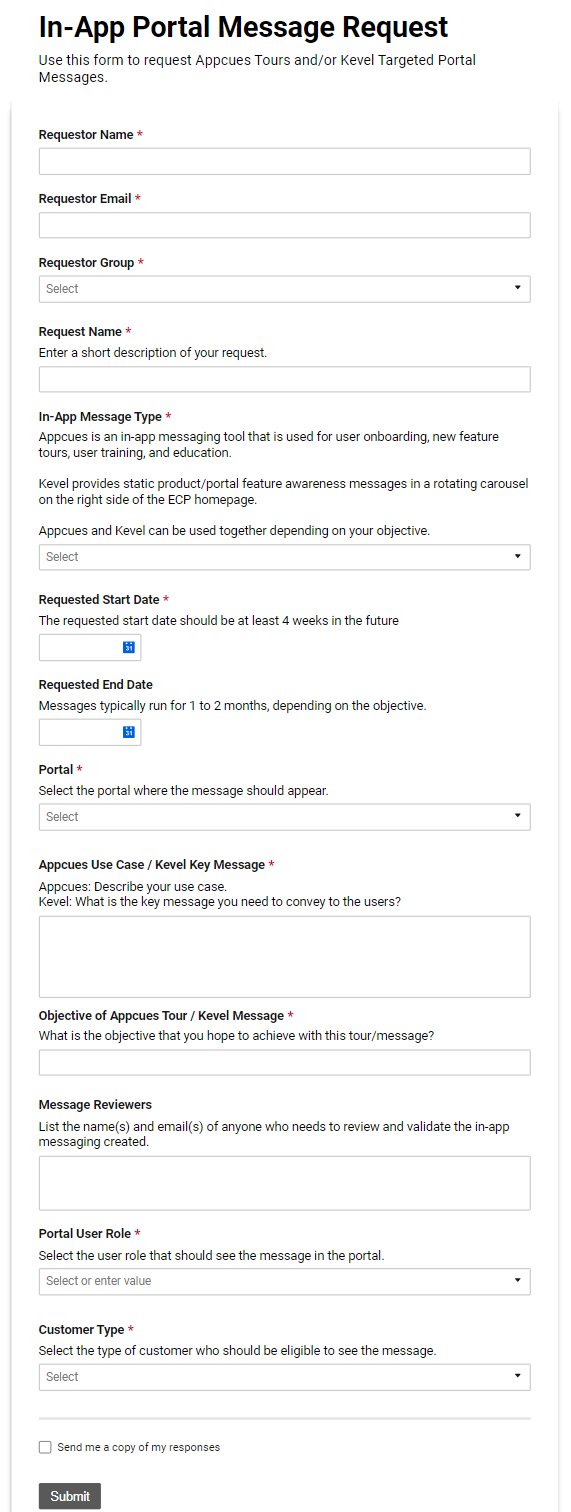
- Designed a cross-functional intake process: a requester fills out a request form, an Appcues Lead or UX Writer vets it with Customer Communications, Product Marketing, and Support/Success, then work is tracked as a Jira ticket assigned to a UX Writer.
- Wired up data-driven targeting through Segment (for audience and event data) and measurement through Amplitude (for conversion funnels), so every tour had a defined goal and a way to know if it worked.
- Built a standard build process — define goals, identify audience, map the user journey, draft messaging, design the flow, test in UAT, deploy, then iterate using A/B tests and user feedback.
- Tracked results monthly in Appcues' own analytics and rolled them into quarterly Smartsheet reporting shared with stakeholders.
3 Result
Average tour completion rate climbed from a 40% benchmark to 55% within a single quarter (Q3), and in-app engagement grew 106% year-over-year. Feature conversion rates ranged from 10% to 70% depending on the tour, and focused, well-targeted messaging cut customer support questions by 40% and support cases overall by 26%.
The program also became the connective tissue between Customer Communications, Product Marketing, and Support — instead of each team improvising its own way to reach users in-product, everyone now had one well-measured channel.